
Why Most Service Businesses Don’t Have a Lifecycle
You’d think this would be obvious.
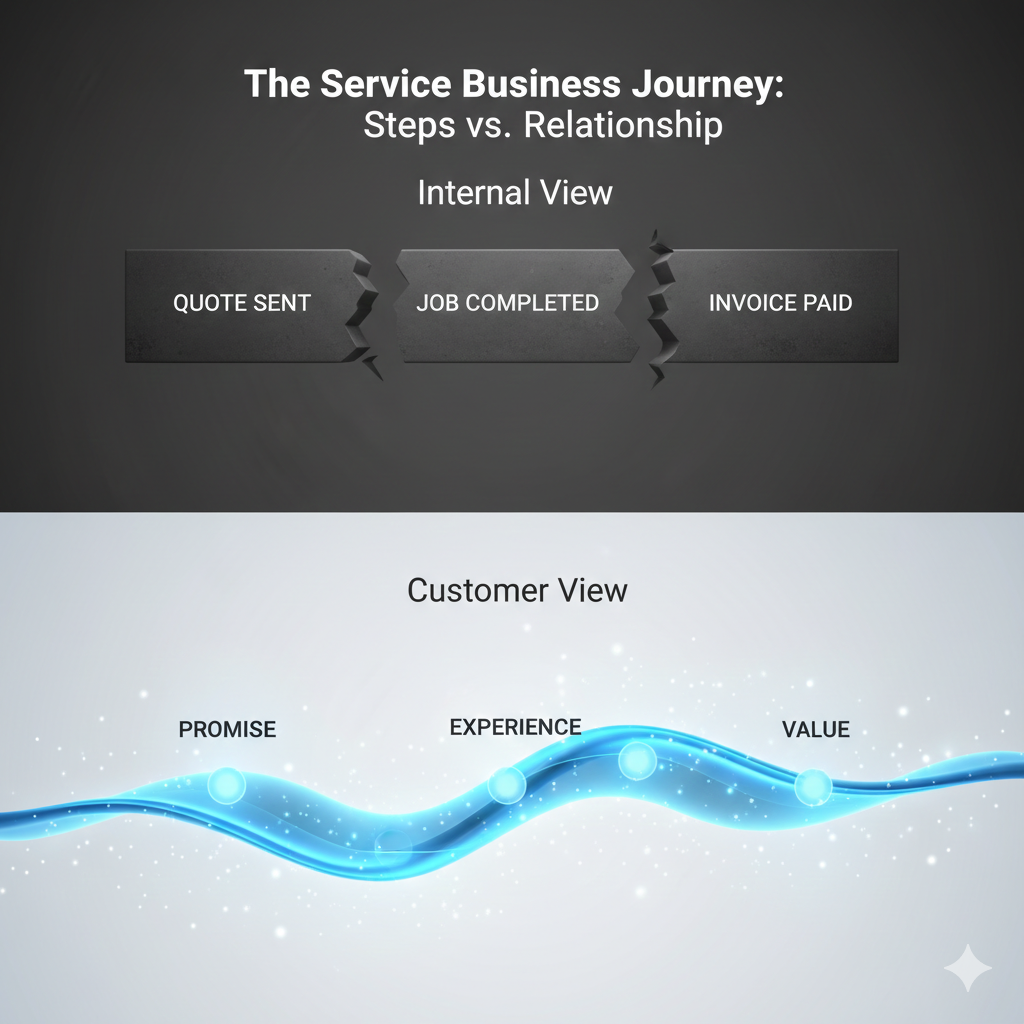
But most service businesses don’t actually have a lifecycle. They have steps. Disconnected checkpoints.
- A quote goes out.
- A job gets booked.
- An invoice is sent.
That’s the internal view. It makes sense operationally.
But to the customer?
It’s one continuous relationship.
They don’t see a quote. They see a company making a promise.
They don’t see a job. They see a technician showing up.
They don’t see an invoice. They see value delivered.
The problem is, most systems break at the handoffs:
- No follow-up after quoting
- No message after job completion
- No touchpoint after payment
That’s where revenue leaks — between moments, not during them.
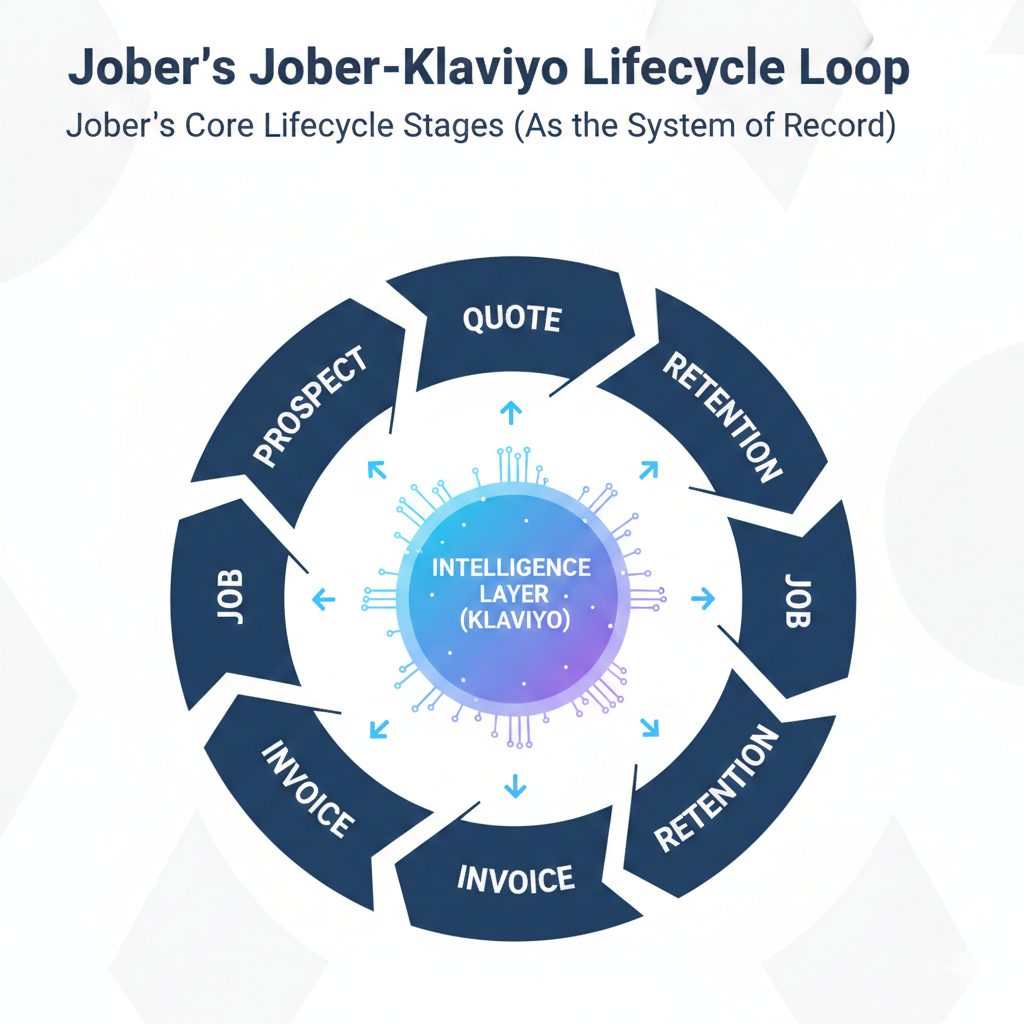
Jobber’s Core Lifecycle Stages (As the System of Record)
Jobber actually has the lifecycle. You’re just not using it that way.
Here’s what’s already in the system:
- Prospect → Quote: Someone expresses interest or you create a proposal.
- Quote → Job: Approval triggers scheduling and fulfillment.
- Job → Invoice: Completion leads to payment.
- Invoice → Retention / Rebooking: The last mile — where long-term revenue lives.
These stages already exist in Jobber — they’re just not treated as a lifecycle.
Which means communication resets at every step. As if each interaction is the first.
It’s not.
It’s one long story. And it’s your job to keep telling it.
Where Lifecycle Automation Breaks Down
This is where the gap shows up.
Jobber tracks the stages.
But most messaging systems — or worse, manual workflows — treat each one as isolated.
- A quote email goes out with no memory of prior touchpoints.
- A job gets done but triggers no follow-up.
- An invoice is paid, and then… silence.
The customer journey becomes a series of unconnected events.
No continuity. No context. No compounding.
Which is exactly where automation should step in — if you’re thinking in lifecycle terms.
How Lifecycle Thinking Changes Automation (continued)
If you build automation around lifecycle transitions, everything changes.
You’re not “sending emails.”
You’re moving people forward with context.
That’s the shift most service businesses never make: automation isn’t about volume. It’s about continuity. It’s about making sure the customer never feels like they fell out of your system the second they took the next step.
Lifecycle automation is what turns Jobber’s steps into a customer experience.
The rule: Automate the transition, not the stage
Stages are what you manage internally.
Transitions are where customers feel friction — or confidence.
So instead of thinking:
- “We send a quote email.”
- “We do jobs.”
- “We invoice.”
You think:
- “What should happen after the quote is sent?”
- “What should happen the moment the job is booked?”
- “What should happen immediately after completion?”
- “What should happen after payment, when trust is highest?”
That’s where conversion, retention, reviews, and rebooking actually live.
What a Real Jobber Lifecycle Looks Like (With Messaging Attached)
Below is a practical lifecycle map that service businesses can actually implement without turning their process into a science experiment.
1) Prospect → Quote (pre-selling the quote)
Goal: Increase approvals by reducing uncertainty.
Automation ideas:
- “What happens next” message right after the quote is sent
- Proof + reassurance (reviews, photos, insurance, guarantees, process)
- A deadline or soft urgency tied to scheduling availability
- A personal follow-up trigger if the quote isn’t viewed/approved
Why it matters: Most quotes don’t get rejected — they get ignored.
2) Quote → Job (confirmation + expectation-setting)
Goal: Reduce cancellations and tighten operational flow.
Automation ideas:
- Booking confirmation with clear expectations (arrival window, prep steps, parking, pets, access)
- Technician intro (name, photo if possible, role, what they’ll do)
- Reminder cadence that doesn’t feel like spam (timed, not repeated)
- “Reply with questions” prompt that routes to your team fast
Why it matters: The job doesn’t feel booked to the customer until they feel prepared.
3) Job → Invoice (post-service follow-up that protects value)
Goal: Prevent the “we showed up and left” experience.
Automation ideas:
- “Job complete” message with recap (what was done + any notes)
- Care tips / maintenance instructions (reduces support calls)
- Upsell that’s actually relevant (next logical service, not random promos)
- Review request timed after value is felt, not when you feel like asking
Why it matters: This is the exact moment your trust is highest — and most businesses go silent.
4) Invoice → Retention / Rebooking (the revenue stage nobody builds)
Goal: Turn a one-time job into a repeatable relationship.
Automation ideas:
- Payment confirmation + thank you that feels human
- “What to expect next time” or seasonal guidance
- Rebooking nudges based on service type (30/60/90/180 day logic)
- Referral ask that doesn’t feel needy (tie it to a specific outcome)
Why it matters: Retention isn’t a campaign. It’s a system.
The Two Common Failure Modes (And Why They Keep Happening)
Failure Mode #1: Messaging that ignores context
Most systems blast the same template to everyone.
But the customer is thinking:
- “Do they remember what I asked for?”
- “Do they know where I’m at in the process?”
- “Am I just a ticket number?”
Context is the difference between “automation” and “experience.”
Failure Mode #2: Jobber data stays trapped inside Jobber
Jobber holds the truth:
- quote sent
- quote approved
- job scheduled
- job completed
- invoice paid
But if your messaging platform can’t react to those events, you don’t have a lifecycle.
You have software.
What This Looks Like When Jobber and Klaviyo Are Properly Connected
This is where the loop actually becomes real:
- Jobber becomes the system of record for lifecycle stages
- Klaviyo becomes the system of engagement for lifecycle messaging
- And each transition triggers communication that matches the customer’s reality
You stop thinking like a dispatcher.
You start thinking like a lifecycle operator.
That’s the difference between sending emails and building revenue infrastructure.
Quick Self-Audit: Do You Have a Lifecycle or Just Steps?
If you answer “no” to any of these, you don’t have a lifecycle yet:
- Do approved quotes trigger expectation-setting automatically?
- Do completed jobs trigger follow-up, review, or rebooking logic?
- Do paid invoices trigger retention touchpoints?
- Can you segment customers by lifecycle stage without manual tagging?
- Can you prove that post-job messaging increases repeat bookings?
Most businesses can’t — because the transitions are unowned.
The Revenue Leaks Are Between the Stages
Jobber gives you the stages.
But lifecycle revenue comes from what happens between them.
If your customer experience resets at every handoff, your growth will always be capped — no matter how many leads you generate.
Because the best service businesses don’t just win the job.
They win the next one.