
Most GLP-1 patient engagement programs are built on a calendar. Day 7, day 14, day 30, then monthly. It's tidy, easy to schedule, and blind to almost everything that matters.
Patients don't experience treatment in neat 30-day blocks. They experience it as a string of moments: a dose increase that brings fresh nausea, a week when the scale stops moving, a refill date that sneaks up on them. Those moments decide whether someone stays.
In most programs, they pass in silence.
Why a calendar can't see what your patients are going through
A calendar-based lifecycle sends the same email to a patient who just moved up a dose and a patient who has been stable for six weeks. One needs reassurance. The other needs something else entirely. Both get a generic check-in.
The patient on the new dose may be dealing with side effects for the first time. The generic message doesn't acknowledge it, and the silence that follows says more than the email did.
Strong GLP-1 patient engagement starts with a different question. Not "what do we send this week?" but "what is each patient going through right now, and what do they need to hear because of it?" Answering that at scale takes clinical-journey fluency and marketing-systems thinking working side by side, a pairing most programs don't have in one room.
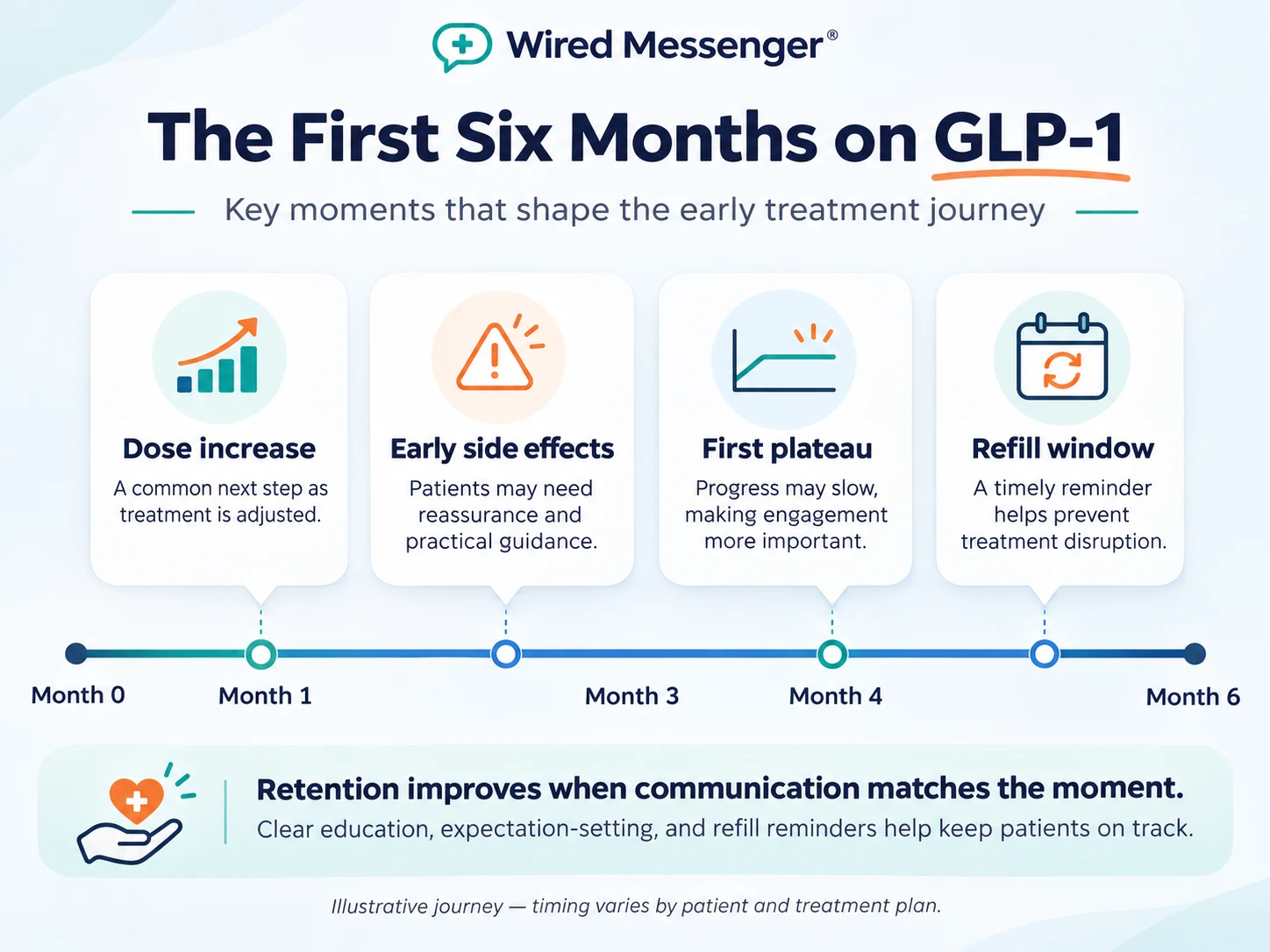
Four moments where silence costs you patients
The exact risk points vary by protocol, but four show up in nearly every program. Each one is a test of GLP-1 patient engagement, and each one is easy to miss.
Dose escalation
Every titration step is a small decision point. The patient knows a change is coming, may have read about what can come with it, and is often nervous. A message that arrives before the increase, framing what to expect and where to take questions, turns an anxious week into a supported one. Silence sends them to online forums for answers.
Early side effects
Nausea, fatigue, and appetite changes are common in the early weeks, and they're where many patients first wonder whether treatment is worth it.
Email isn't the place for medical advice, and it shouldn't try to be. Its job is narrower and just as important: making sure the patient knows the care team is reachable, that what they're feeling was anticipated, and that reaching out is expected rather than a bother. Clinical guidance belongs to providers. The dependable reminder that help exists belongs to the lifecycle.
The first plateau
Sooner or later, progress slows. For a patient paying monthly, a stalled number can feel like a broken promise.
This calls for perspective, not promotion: recognition of what has improved beyond the scale, and a reminder that their provider can review the plan with them. A discount offer here reads as desperation.
Refill windows
To the operator, a refill is an operational event. To the patient, it's a recurring decision to keep paying. A reminder that arrives late, or one that follows a failed payment with no clear fix, turns a routine renewal into an exit. Timed well, the refill touchpoint quietly reaffirms why they started.
Spotting these moments is the easy part. Responding to each one reliably, for every patient, is where real expertise shows.
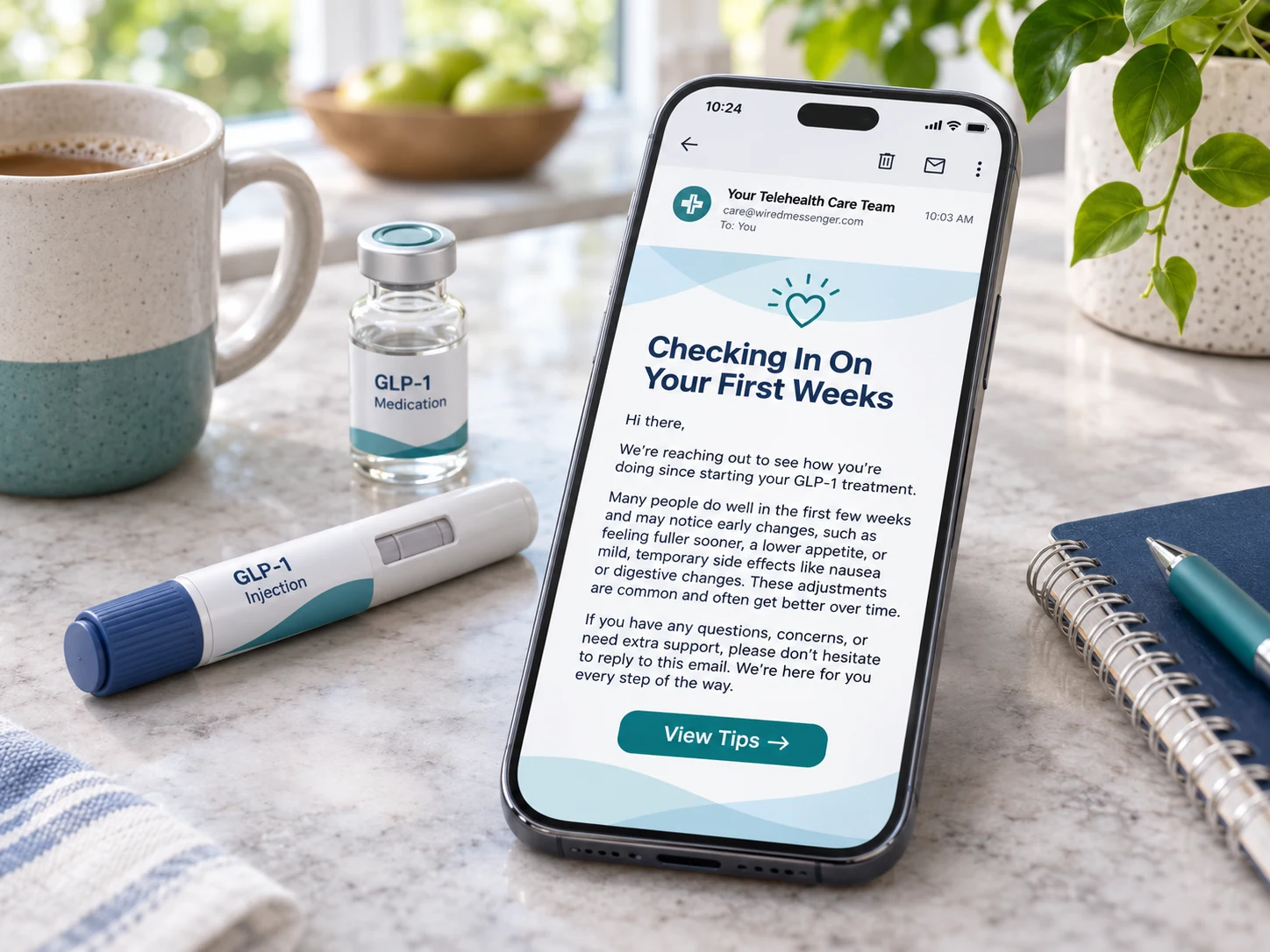
What it takes for email automation to catch these moments
Every one of those moments is already visible somewhere in your data. Dose stage sits in the prescribing record. Refill timing sits with the pharmacy. Payment status sits in billing, and check-in responses live in whatever tool collected them.
Email automation can only act on what it can see.
When those signals reach your ESP through proper integration, a scheduled dose change can trigger the right message days ahead of time, a skipped check-in can route a patient to the care team, and a failed payment can pause promotional sends until it's resolved. Without them, the program is back to guessing by date.
Then there's compliance. What can appear in a subject line, which data can sync to a marketing platform, and how consent is captured all carry HIPAA implications. We go deeper on that in HIPAA-compliant email automation.
Done well, the patient never sees the machinery. They simply notice that the program seems to know where they are. That impression is engineered, and it takes a team fluent in both the patient journey and the systems behind it.
Silence sends a message too
Patients notice when a program goes quiet at the hardest points in treatment. They read it as indifference, even when it isn't.
Effective GLP-1 patient engagement treats dose changes, side effects, plateaus, and refills as the moments that define the relationship. It picks up where a strong GLP-1 onboarding email sequence leaves off, and it's central to the retention lifecycle outlined in GLP-1 patient retention.
If your lifecycle still runs on a calendar, it may be time to rethink what it's listening for. Wired Messenger's help telehealth teams build programs that show up when patients need them most.