
Most GLP-1 patient retention problems don't begin at month three. Month three is simply when they show up in the revenue report.
By the time a patient cancels, the decision has usually been building for weeks. A first shipment that arrived late. A question about nausea that sat unanswered for two days. A dose increase nobody explained, or a refill reminder that landed after the last pen was already used.
None of these moments feels like a crisis on its own.
Together, though, they write the story a patient tells themselves about whether the program is worth the monthly charge. If you've read our guide to email lifecycle marketing for telehealth, you know drop-off is rarely random. This piece looks at the other side of the problem: what a lifecycle built for retention actually looks like, from first consult to year two.
For what that drop-off is actually costing programs every month, see Why Programs Are Losing $200–$400 Per Patient Every Month.
Why sending more emails rarely fixes churn
When GLP-1 patient retention slips, the instinct is to add volume. Another newsletter. A day-30 check-in. A promo code for patients who look shaky.
The trouble is that a patient's experience on treatment doesn't run on a calendar. It runs on events: consult, approval, pharmacy fill, shipment, first injection, the first dose increase, the first week the scale refuses to move. A program built around send dates can't see any of that, so it talks past the patient at exactly the moments they most need to hear from you.
To someone dealing with side effects, a cheerful promotional email doesn't read as engagement. It reads as proof that nobody is paying attention.
A retention-first lifecycle flips the logic. Every message exists because something happened in the patient's journey, or because something that should have happened didn't. Designing that logic well takes more than good copy. It takes a team that understands both the clinical rhythm of treatment and the systems that track it.
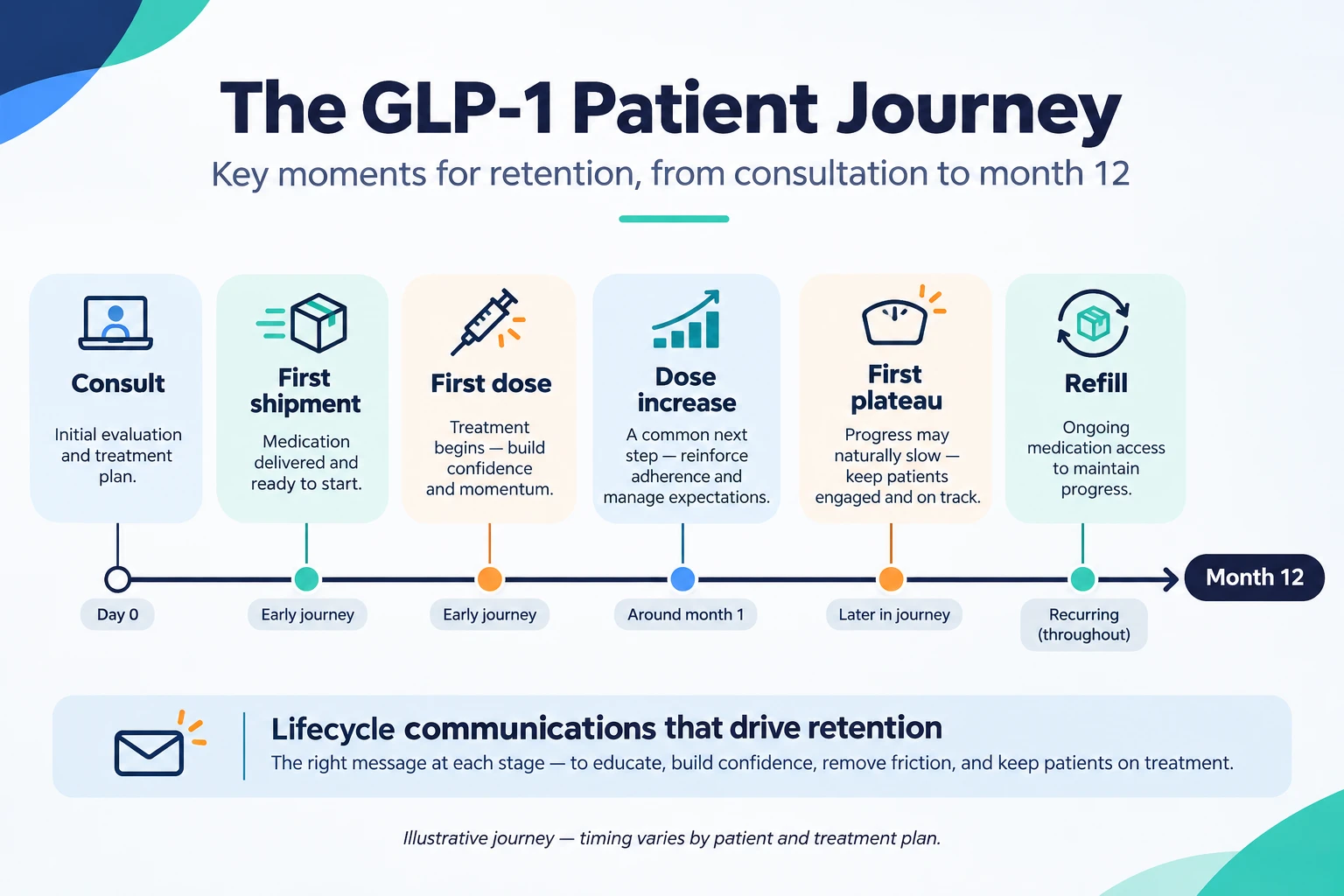
Where the GLP-1 patient journey bends — and where it breaks
Not every stage of treatment carries equal risk. Programs with strong GLP-1 patient retention concentrate their effort where patients are most likely to drift, and they change the purpose of each message as the patient moves forward.
The first 14 days: setting expectations
Between consult and first dose, motivation is at its peak and patience is at its lowest. Patients want three answers fast. Was I approved? When does it arrive? What happens next?
Silence in this window reads as disorganization, and it colors everything that follows. A well-built GLP-1 onboarding email sequence, answers those questions before the patient has to ask, and quietly prepares them for what the first few weeks may feel like.
Months one through three: the fragile middle
This is where telehealth patient retention is won or lost. Dose increases bring new side effects. Early results slow down. The novelty fades, and the monthly charge starts to feel heavier.
Messaging here can't be generic. It has to respond to where each patient actually is: their dose stage, their refill window, whether they answered a check-in or went quiet. It also has to stay inside HIPAA's lines, which limits what can appear in a subject line, a preview, or a text message.
Past month three: from reassurance to reinforcement
Patients who clear the 90-day mark behave differently, and this is where the investment in GLP-1 patient retention starts to pay back. The lifecycle's job shifts from calming nerves to reinforcing progress through milestone recognition, refill continuity, and early conversations about long-term care.
Patients who do lapse aren't necessarily gone, either. A structured win-back program often recovers revenue most operators have already written off. Knowing which patients are worth that effort, and when to reach them, is a judgment call that comes from experience.

What sits underneath strong GLP-1 patient retention
Every moment described above depends on data your email platform probably doesn't have.
Approval status lives in the EHR. Fill and shipment status live with the pharmacy partner. Failed payments live in billing, and check-in responses may sit in a separate intake tool entirely. When those systems don't talk to your ESP, the lifecycle is guessing — and guessing is how a patient whose refill just failed receives a congratulatory milestone email.
That's why we treat email integration as the foundation rather than an add-on. Connecting clinical, pharmacy, and billing data to the marketing stack, in a HIPAA-conscious way, is what lets a program see the patient journey at all.
Email automations are what act on that visibility. Flows that branch by dose stage. Suppression rules that pause promotions the moment something goes wrong. Escalation paths that flag a quiet patient for the care team before they cancel, not after.
None of it is set-and-forget. Protocols change, pharmacy partners change, pricing changes, and the automations have to keep pace.
This is the part of GLP-1 patient retention most in-house teams underestimate. It sits where lifecycle strategy, data engineering, compliance, and healthcare-appropriate copywriting overlap — four disciplines rarely found in a single hire, and exactly the combination a specialist partner brings on day one.
Retention is designed, not hoped for
Patients rarely leave a GLP-1 program because of one bad email. They leave because, across dozens of small moments, nothing in the experience gave them a clear reason to stay.
Durable GLP-1 patient retention comes from a lifecycle that knows where each patient is and responds accordingly. That means integrated data, automation built around real treatment milestones, and a team that understands both the clinical journey and the technology carrying it.
If your program is losing patients somewhere between the first shipment and the third refill, it may be time for a conversation. Wired Messenger's email automation and integration services are built for exactly this stage of growth, and the posts that follow in this series take a closer look at each part of the journey.