
0
+
Years Lifecycle Experience
0
Day Foundation Build
0
+
ESP Platforms Supported
0
Weeks
Avg Time to First Live Flow
CERTIFIED & VERIFIED



Who This Is For
You're running a serious subscription healthcare program. You're past the fundamentals.
You've built something real — a GLP-1 program, a telehealth platform, a concierge or pharmacy-led program generating $1M–$10M+ a year. You have a product that works, a team that's committed, and patients coming in.
Acquisition is working. Retention isn't.
You're spending on paid channels, referrals, and partnerships to bring patients in — but somewhere between onboarding and month three, they're leaving. Refill rates are lower than they should be. Churn is eating into the margin you worked hard to build.
- Your data is fragmented across CRM, EHR, pharmacy, and ESP with no clean connection between them.
- Your ESP is half-configured — nobody's really owning it or building the lifecycle infrastructure it was designed to run.
- You've tried fixing it — a freelancer, an agency, someone in-house — and it's still not resolved.
- The LTV you're projecting on paper isn't showing up in the actual numbers.
- Nobody on your team actually owns the lifecycle — because building it properly requires skills that most programs can't staff in-house.
We're not the right fit if — You don't yet have patients coming in, or you need a quick-fix campaign without the infrastructure to back it up. We do our best work with programs that have figured out acquisition and are serious about building the retention engine that makes it profitable.

The Problem
Most GLP-1 programs send emails. Very few have a lifecycle layer that actually works.
Drop-off isn't a content problem or a frequency problem. It's what happens when your intake data never makes it cleanly into your ESP, your refill triggers fire on incomplete signals, and your team is manually patching together what should be automated.

Broken Data Handoffs
Patient data from intake, EHRs, and pharmacy platforms doesn't flow cleanly into your ESP — automations fire on incomplete or inaccurate signals.

Refill & Retention Gaps
No reliable mechanism to trigger refill reminders, treatment check-ins, or re-engagement based on actual patient lifecycle status.

Compliance Exposure
SMS and email opt-outs aren't synced. HIPAA-compliant messaging architecture is an afterthought, not a foundation.

Backend Chaos at Scale
Manual imports, developer-dependent workarounds, and undocumented flows that break every time the team grows or the platform changes.

No Lifecycle Ownership
Email blasts go out, but no one owns the full patient journey — from intake through refill, renewal, and re-engagement.
$200–$400
Lost per patient, per month
The number we hear most often. For a program at your scale, that's a material number — and it compounds in the wrong direction every month the lifecycle isn't fixed.


Why It Keeps Not Getting Fixed
Three root problems. In sequence.
These aren't surface-level symptoms you can fix with a new template. They're structural — and they happen in order. Step 1 creates Step 2. Step 2 makes Step 3 impossible. Until all three are addressed, your program keeps leaking at the same points.

No Strategy in Place
You're acquiring patients — but there's no system guiding what happens next.
- No single source of truth — patient data split across CRM, EHR, intake, pharmacy, and ESP
- No lifecycle map — you're guessing at the 30, 60, and 90-day drop-off cliff
- No messaging framework built around the patient journey
- No visibility into which touchpoints drive refills and which accelerate churn

No Systems to Execute It
Even if the strategy exists on paper, the systems to run it aren't built.
- No integration connecting your stack to a single source of truth
- ESP not configured — event triggers and segmentation never set up properly
- No in-app or push infrastructure — the channel keeping patients engaged between touchpoints is unused
- Compliance and cadence unmanaged — over-sending, under-sending, and compliance gaps happening simultaneously

No People to Run It
Even with strategy and systems, most programs don't have the team to run it.
- No lifecycle owner — nobody responsible for the roadmap or connecting the dots between teams
- No technical talent who can build data integrations or configure complex event architecture
- No platform expertise — the team doesn't know the full capability of the ESP they're paying for
- No bridge between technical and marketing — that person doesn't exist in-house
The pattern underneath all of this: Every approach most programs try solves one piece of the puzzle. But building a real healthcare lifecycle requires strategy, systems, and people working together simultaneously. Most vendors can do one. Wired Messenger does all three — and we connect them.
What You've Already Tried
Why it keeps not working.
Most programs we speak with have already invested time, money, and energy into solving this. Here's what they tried, why it felt like it should work, and why it didn't.
- Hired a Freelancer
- Brought on a General Email Agency
- Tried to Do It In-House
- Set Up an ESP and Called It Done
- Got an Audit — Then Had No One to Execute It
Every approach above solves one piece. Building a real healthcare lifecycle requires strategy, systems, and people working together simultaneously. Most vendors can do one. A few do two. Wired Messenger does all three — and we've done it inside live subscription health programs.
Felt right because
Fast, cheaper than an agency, and they've worked with ESPs before.
Why it failed
Freelancers can set up a template or configure a flow. They can't architect a data integration, own a lifecycle roadmap, or speak the language of your technical and marketing teams simultaneously. Work gets delivered, nobody owns it afterward, and within 90 days you're back at square one.
Still unsolved
No strategy. No data layer. No one maintaining or optimizing anything after handoff.
Felt right because
They've run campaigns for other brands, they know Klaviyo, and they have case studies.
Why it failed
A general email agency knows how to run campaigns. They don't know FHIR, EHR integrations, healthcare compliance, or how to architect a patient lifecycle across onboarding, refill, and churn. They don't have a technical lead who can build the data infrastructure.
Still unsolved
Data still disconnected. No lifecycle infrastructure. Beautiful campaigns sitting on a broken foundation.
Felt right because
You already have a team, you control the timeline, and it seems more efficient.
Why it failed
The team is already stretched. Email becomes the thing nobody has time for. Sends are inconsistent, nothing is properly automated, and the skill set required — lifecycle strategy, data integration, platform expertise, direct-response copywriting — rarely exists in one person or one team at this stage.
Still unsolved
No ownership. No system. No compounding. Just reactive sends when someone remembers.
Felt right because
The platform is live, you're technically set up, and templates are in there.
Why it failed
A platform without a strategy, data architecture, and lifecycle build is just an empty engine. Events aren't firing correctly. Flows sit empty or send the wrong message to the wrong person. You're paying for a Ferrari and using it as a golf cart.
Still unsolved
Platform configured but not connected to patient behavior. No personalization. No compounding lifecycle.
Felt right because
At least you know what needs to be done. A roadmap is better than nothing.
Why it failed
A document of recommendations without execution is an expensive frustration. The audit identifies the gaps, but if there's no team to build the integrations, configure the ESP, write the lifecycle messaging, and maintain it — nothing changes.
Still unsolved
Clarity without capability. You know what's broken — but still can't fix it.
The Lifecycle Infrastructure System™
Strategy + Systems + People.All three. Working together.
Every Wired Messenger engagement is built on the same foundational model. We don't just "do email." We install and operate the full lifecycle infrastructure — the strategy layer, the data and integration architecture, and the team to run it.
Most vendors hand you a deliverable and move on. We come in as your lifecycle operator.

Strategy First — Always
We audit before touching a single template. Every drop-off point surfaced, every churn trigger mapped, 90-day roadmap delivered.
- Patient journey mapping
- Drop-off diagnosis
- 90-day prioritized roadmap
- Persona & messaging framework
Data & Integration Architecture
We build and host WiredConnect — our proprietary middleware connecting EHRs, pharmacy, intake tools, and CRMs to your ESP.
- WiredConnect middleware
- FHIR R4 / EHR integrations
- API, webhook, event architecture
- Incremental sync & QA
ESP / SMS / In-App Infrastructure
Full platform configuration with the account architecture, event logic, segmentation, and trigger structure your patient lifecycle requires.
- Customer.io & Klaviyo
- SMS & compliance setup
- In-app & push notification
- Full platform capability unlocked
Lifecycle Build & Messaging
Every flow built — onboarding, refill, churn prevention, win-back, upsell — tailored to where patients are in their health journey.
- Refill & renewal flows
- Churn rescue sequences
- Win-back & re-engagement
- Brand positioning & copy
Ongoing Operations & Optimization
We operate it after we build it. QA, campaign execution, A/B testing, monthly reporting, and lifecycle ownership — week over week.
- Campaign execution
- A/B testing cadence
- Performance reporting
- Ongoing optimization
The Team: Strategy + Technical + Marketing
A lifecycle strategist, a technical lead, and marketing talent who understands the patient. One team — no hiring overhead, no coordination gaps.
- Lifecycle roadmap ownership
- Technical & marketing bridge
- Healthcare compliance fluency
- Scales with your program
We are not an email agency.
Email is one output of the lifecycle layer, not the service. We build and operate the infrastructure that makes every patient touchpoint — email, SMS, push — fire on the right signal at the right moment. The infrastructure we build belongs to you. The expertise that runs it comes with us as your partner.
Proprietary Technology
The middleware layer your
EHR can't provide.
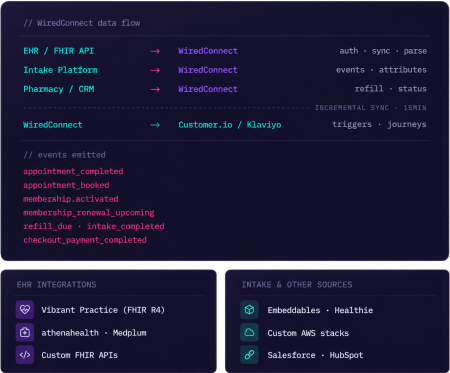
WiredConnect is our owned middleware platform that connects EHRs, scheduling systems, intake tools, pharmacy platforms, and CRMs to Customer.io and other ESPs — cleanly, reliably, without custom development on your end.
- OAuth2 auth & token management — no manual credential handling or developer overhead.
- Incremental sync every 15 minutes — patient, appointment, and membership data always current.
- Event emission & derived attributes — lifecycle triggers built on real patient signals, not manual exports.
- Hosted, monitored, and maintained by us — zero infrastructure burden on your team.
The Phased Roadmap
From broken to operational in 90 days.
We don't drop a platform and disappear. We build the lifecycle in phases — audit first, foundation second, operations third. Each phase builds on the last. By Step 3, the lifecycle is running, compounding, and owned.
1
Lifecycle Audit & Strategy
We come in as your strategic operator. We audit the full landscape — data systems, ESP, patient journey, drop-off points — and deliver a clear, prioritized 90-day roadmap. This is the foundation everything else is built on.
Starting at $2,500 · One-time · Credited toward Foundation Build
- Deep stack audit — CRM, EHR, ESP, intake, pharmacy integrations
- Data & lifecycle audit — every drop-off point surfaced
- Patient journey mapping — the $200–$400/patient leak identified
- 90-day prioritized roadmap — quick wins first, complex builds sequenced
2
Foundation Build
We execute the roadmap. Data integrations built and live. ESP configured to the patient lifecycle. Priority flows built, tested, and launched. This is where the infrastructure gets installed and the lifecycle goes live.
Get a scoped quote for your program →
- WiredConnect middleware build — EHR, CRM, pharmacy → ESP
- ESP full configuration — segmentation, trigger logic, compliance
- Lifecycle messaging build — onboarding, refill, churn rescue, win-back
- SMS & in-app setup — coordinated cross-channel cadence
- QA, testing, and launch support — validated end-to-end
3
Ongoing Operations
We operate the lifecycle layer as your dedicated partner. This is where compounding happens — optimization, churn prevention, patient expansion, and LTV growth month over month.
Tell us about your program — we'll tailor a plan →
- Campaign execution & lifecycle operations
- Churn prevention & patient expansion flows
- A/B testing cadence with documented learnings
- Monthly performance reporting — lifecycle metrics, LTV trends
- Ongoing strategy adaptation as your program grows
Client Work
Real programs. Real infrastructure.
From GLP-1 telehealth platforms to concierge medicine practices — here's what lifecycle infrastructure looks like when it's built right.

Fridays Health
GLP-1 Telehealth Platform · Customer.io · Twilio · Embeddables · Delivered in 2 weeks
Fridays had SMS and email running, but lacked a unified opt-out flow creating compliance risk, broken Embeddables event tracking that prevented lifecycle campaigns from triggering reliably, and no confidence that paid media lead data was flowing correctly into the lifecycle layer.
- SMS compliance live — unified opt-out automation syncing Twilio and Customer.io, eliminating manual handling.
- Embeddables integration expanded with 10+ custom events — lifecycle campaigns now fire on real patient behavior.
- All 5 primary campaigns (Welcome, Abandoned Quiz, Abandoned Product, Abandoned Checkout, Retention Sequence) tested and validated end to end.
- Paid acquisition leads now enter lifecycle journeys with the right data attached — Fridays can scale acquisition confidently.
Customer.io
Lifecycle Platform
Twilio
SMS Integration
Embeddables
Intake / Event Tracking
HIPAA-Compliant Opt-Out Architecture
Compliance
2Weeks
Delivered on schedule
10+
New lifecycle events mapped
5
Campaigns validated E2E
1
Unified opt-out workflow

VelvetRx
Prescription Weight Management · Customer.io · Custom AWS Stack · 3 weeks + ongoing retainer
Acquisition was live, but lifecycle communication couldn't be reliably implemented because the data architecture between intake and Customer.io wasn't built to support it. No clean mapping of intake data, incomplete event payloads, and no plan for subscription lifecycle events like refills, status changes, and renewals.
- Reliable real-time data flow established between the intake funnel and Customer.io — the first time this program had clean, actionable patient data in the ESP.
- Accurate segmentation enabled based on intake responses and product selection — messaging now reflects what patients told the program about themselves.
- Future refill, renewal, and status change automation de-risked — event model designed to support these without architectural rework.
- VelvetRx retained Wired Messenger for ongoing operations — now building onboarding, adherence, and re-engagement flows on the data foundation.
Customer.io
Lifecycle Platform
Custom AWS Intake Stack
Data Source
21 Intake Attribute Mappings
Data Architecture
State-to-Timezone Mapping Logic
Personalization
3Weeks
Initial implementation
4
Checkout events architected
21
Intake attributes mapped
∞
Ongoing lifecycle retainer

Extension Health
Concierge Medicine / Direct Primary Care · WiredConnect · Vibrant Practice FHIR R4 · Customer.io
Extension Health had patient data in their EHR and a Customer.io account — but the two systems were not connected. Without a data layer between them, appointment follow-up, membership renewal, and patient winback were all manual or non-existent.
- Real-time patient, appointment, and membership data flowing from Vibrant Practice into Customer.io via WiredConnect.
- 8+ lifecycle automations now technically supported — post-appointment follow-up, winback, birthday messaging, upsell, membership renewal, and more.
- Derived attributes computed automatically — no manual data handling or exports required by the practice's team.
- Middleware hosted, monitored, and maintained by Wired Messenger — zero infrastructure burden on the client.
WiredConnect Middleware
Proprietary Platform
Vibrant Practice FHIR R4
EHR Source
Customer.io
Lifecycle Platform
OAuth2 Auth + Incremental Sync
Architecture
4
FHIR resources synced
4
Lifecycle events emitted
8+
Automations enabled
15min
Incremental sync cadence

What Clients Say
Trusted by teams who need it done right.
Georgia Aquarium

We partnered with Wired Messenger for our migration from Iterable to Customer.io and couldn't be happier. Our setup is complex and far from out-of-the-box, but their team was on top of it from day one — even with tight, hard-stop deadlines.
Aaron DeGroot

They helped us implement a robust automated trigger series, new segments, and audience lists. They are a breeze to work with. I highly recommend their services.
Denis J. Vandal

Wired Messenger makes my life easy. I never have to lift a finger and can rest comfortably knowing that my program is in good hands.
Mubina Kara

We've had such a positive experience working with Wired Messenger. Their team goes above and beyond to keep our website updated, fresh, and running smoothly. They didn't just "get the job done", they took the time to understand our needs, offer thoughtful recommendations, and deliver results that truly support our business. It's rare to find a marketing agency that combines technical expertise with genuine care for its clients, and we couldn't be happier with the service and support we've received. Highly recommend!
Barb Keck

Thank you for your professionalism in the work flow from the beginning to the end of my required project. From here I'm able to start building my database into the different audience types we cater to. Highly recommend Wired Messenger for email database projects.
Andy Deonarine

I have been working with Wired Messenger for 20+ years with various companies in multiple industries and have always found success. The team is prompt, informed and has saved my companies money numerous times while allowing us to better sell our products. Whether it's email management, SEO or data management, they have always performed.
Smuckers

Never once did they tell me “no we can’t” or “what you’re asking can’t be done” or “we don’t have time”. The Wired Messenger team always worked so hard to ensure all got done. They were so dedicated that I would even speak with the team after 5pm to go over changes and approvals. I can’t really say enough great things about how great their team is and how easy they are to work with.
Doug Hexter

The Wired Messenger team have been terrific to work with as they dig in to power up our messaging. I wish we had engaged them when we started using Customer.io several years ago.
20+ Years Of Lifecycle


.svg)


Platform-agnostic. Deep where it matters.


What Your Program Looks Like on the Other Side
You're scaling — not because you're spending more on acquisition, but because the patients you already paid to acquire are staying, refilling, and expanding.
Your churn rate is down. Your LTV is up. You know exactly where patients are in their journey, and there's an automated message going out at every critical moment — day 7, day 30, or the 90-day window where most programs lose them.
Your team isn't scrambling. The lifecycle runs in the background — data flowing, events firing, flows optimizing. Leadership can focus on growth instead of firefighting the backend.
Every month feels less like guesswork and more like a compounding system.
30–40%+ Revenue from lifecycle channels
Email, SMS, and in-app driving a material share of program revenue — not just a support channel.
Churn rate measurably down
Patients staying through the critical 3 and 6-month windows where most programs lose them.
LTV increasing quarter over quarter
Refill and renewal rates improved — not by discounting, but by the right message at the right time.
Single source of truth
All patient data flowing cleanly into one connected system — no manual exports, no fragmentation.
Common Questions
Everything you need to know before the call.
If your question isn't here, bring it to the discovery call. Ray will spend 30–60 minutes understanding your current setup — not pitching.
Not exactly. Email is one output of the lifecycle layer we build — not the service itself. We build and operate the full infrastructure: data integrations, ESP architecture, lifecycle strategy, and ongoing operations. A lot of agencies send emails. Very few own the backend that makes those emails fire on the right signal at the right moment. That's what we do.
WiredConnect is our proprietary middleware platform that connects your EHR, intake tools, pharmacy platform, or CRM to Customer.io and other ESPs. It handles authentication, data retrieval, event emission, incremental sync, and ongoing monitoring. We own, host, and maintain it — so you get enterprise-grade integration infrastructure without any custom development burden on your team.
Yes — WiredConnect is a differentiator, not a requirement. If you have a working data layer (Segment, developer-built webhooks, a native connector), we can work within it and focus on ESP setup, lifecycle strategy, and ongoing operations. We'll validate your data layer during discovery to confirm it's actually reliable before scoping.
Standard delivery is 90 days for a full Foundation Build. For clients with a simpler stack or an existing data layer, we've delivered initial infrastructure in as little as 2–3 weeks (as with Fridays Health and VelvetRx). The timeline depends on scope — we'll give you a clear estimate after the audit.
Yes. HIPAA-compliant messaging architecture and SMS compliance are built into our Foundation Build — not an afterthought. This includes BAA review, compliant opt-in/opt-out automation, Twilio integration, consent capture and documentation, and proper data handling architecture throughout the lifecycle layer.
Customer.io is our primary recommendation. It's the right choice for event-driven lifecycle automation, complex trigger logic, FHIR and API data integration, and multi-channel communication. We're a Customer.io Certified Agency and Implementation Partner — one of a small number globally with that designation. WiredConnect is purpose-built to feed Customer.io.
Engagements typically start with a Lifecycle Audit ($2,500–$5,000), credited toward a Foundation Build ($10,000–$25,000 depending on scope). Ongoing retainers run from $2,500–$8,500/month across three tiers based on patient volume and how much of the lifecycle layer you want us to own. We'll share a specific range on the call before writing anything.
GLP-1 is where we have the most active proof points right now, but our model is built for any subscription-based healthcare program — concierge medicine, direct primary care, telehealth platforms, and pharmacy-led operators. The positioning, the infrastructure, and the lifecycle problems are nearly identical across all four categories.
Not Ready for a Call Yet?
Send Ray a note.
No commitment required.
Still doing your research? That's completely fine. Drop your details below and Ray will personally reply within one business day — no sales pitch, no follow-up sequence. Just a direct answer from someone who has done this inside live healthcare programs.
- Personal reply from Ray — not a CRM sequence
- No obligation, no pitch call scheduled without your consent
- Usually replies within one business day
Three fields. That's it.
Founder & CEO
Two ways to begin.
One clear path forward.

Whether you need clarity before committing or you're ready to scope the full build, I've designed the entry point around what actually makes the engagement successful. I personally handle every discovery call — you'll be talking with someone who has done this inside live healthcare programs, not a salesperson reading a script.
Lifecycle Audit
Not sure where your lifecycle is actually leaking? We audit your full data stack, ESP configuration, and patient journey — surface every drop-off point, and deliver a prioritized 90-day roadmap. The audit fee is credited toward your build if you move forward.
Start with a Full Audit →
Scoping Call
You know you have a lifecycle problem and you're ready to fix it. In 60 minutes we map your stack, confirm the build scope, and you walk away with a specific proposal — clear price, timeline, and deliverables. No generic quotes. No obligation to proceed.
Let's Talk Through My Stack →
Who we work best with : Programs that have already figured out acquisition and are serious about building the retention engine that makes it profitable. If you're generating revenue and losing too much of it to churn, drop-off, or an underperforming lifecycle — we're the right team.