
Every GLP-1 telehealth program has one: a growing list of patients who paused, cancelled, or quietly stopped refilling. Most operators treat that list as history. A well-built patient win-back campaign treats it as the cheapest growth available.
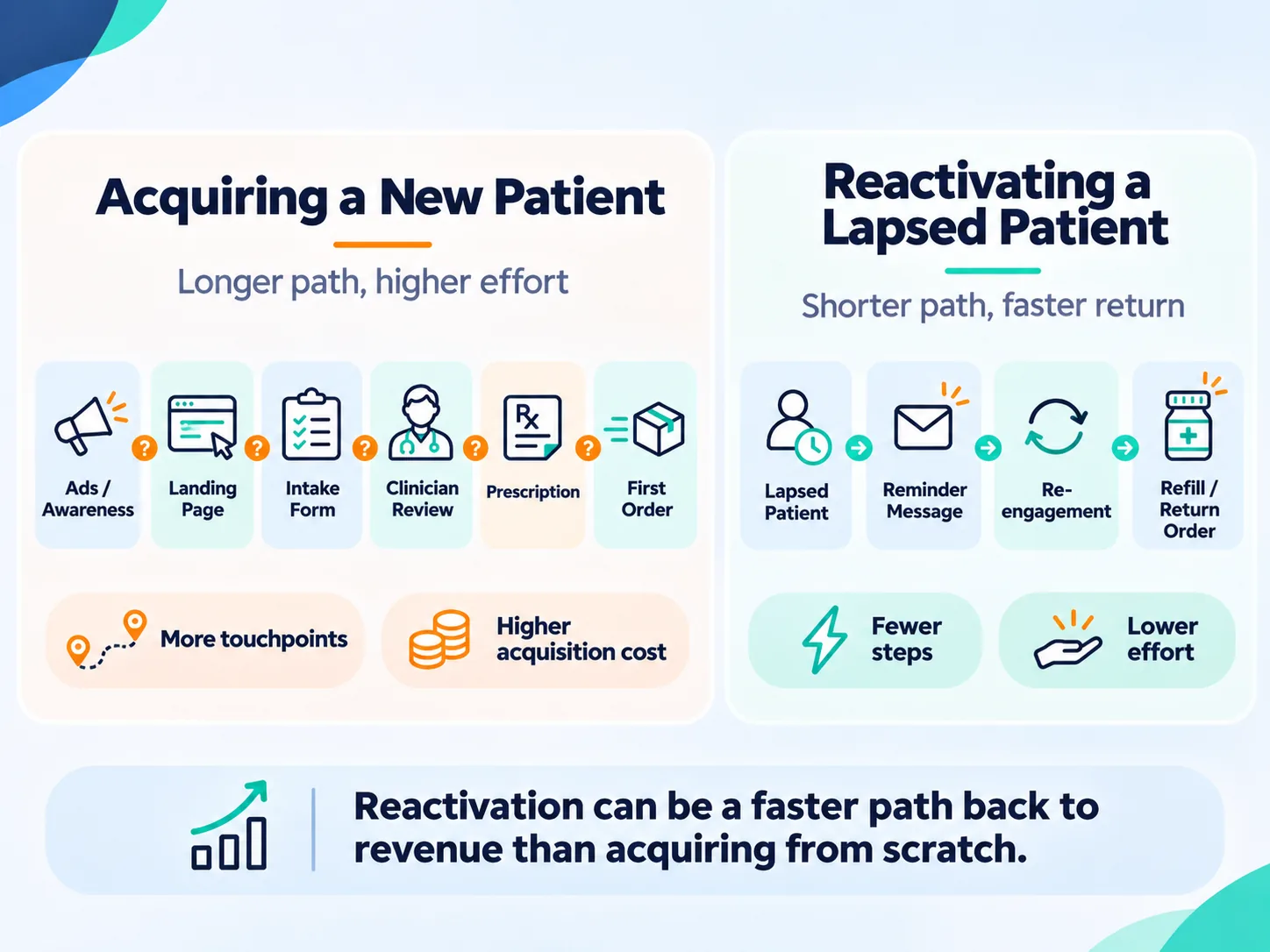
The logic is simple. Each of those patients already cost something to acquire. They found you, trusted you with their health information, completed intake, and paid at least once. Winning one back doesn't mean paying for that first click again.
Yet in most programs, the only thing a lapsed patient ever receives is a single "we miss you" email with a discount code attached.
Why lapsed patients are worth more than new leads
Acquiring new patients in GLP-1 telehealth is expensive, and the competition for them isn't easing. Lapsed patients sit on the other side of that equation. They already know the program, the process, and often the results. Plenty of them left for reasons that had nothing to do with dissatisfaction.
Consider a hypothetical program with 3,000 lapsed patients and an average subscription of $300 a month. Bringing back just 5% of them, 150 patients, adds $45,000 in monthly recurring revenue, with no new acquisition spend behind it.
Every program's numbers will differ. The shape of the opportunity rarely does.
We've written about the true cost of patient churn. A structured win-back program is the part of the answer that keeps working after a patient has already walked out the door.
Why one "we miss you" email isn't a patient win-back campaign
Patients leave for different reasons, and the reason should shape everything about how you approach them.
Some left over cost: a price change, a tighter budget, a shift in coverage. Some left because side effects or a stubborn plateau made treatment feel pointless. Some reached their goal and assumed they were finished. Others drifted after a failed payment or a delayed shipment and simply never came back.
A discount might move the first group. It means nothing to the second, who need to hear that their provider can revisit the plan. The third may be ideal candidates for a maintenance conversation. The fourth just need an easy way back in.
Sending all of them the same email campaign wastes the opportunity. Worse, it can feel tone-deaf to someone who stepped away for a medical reason.
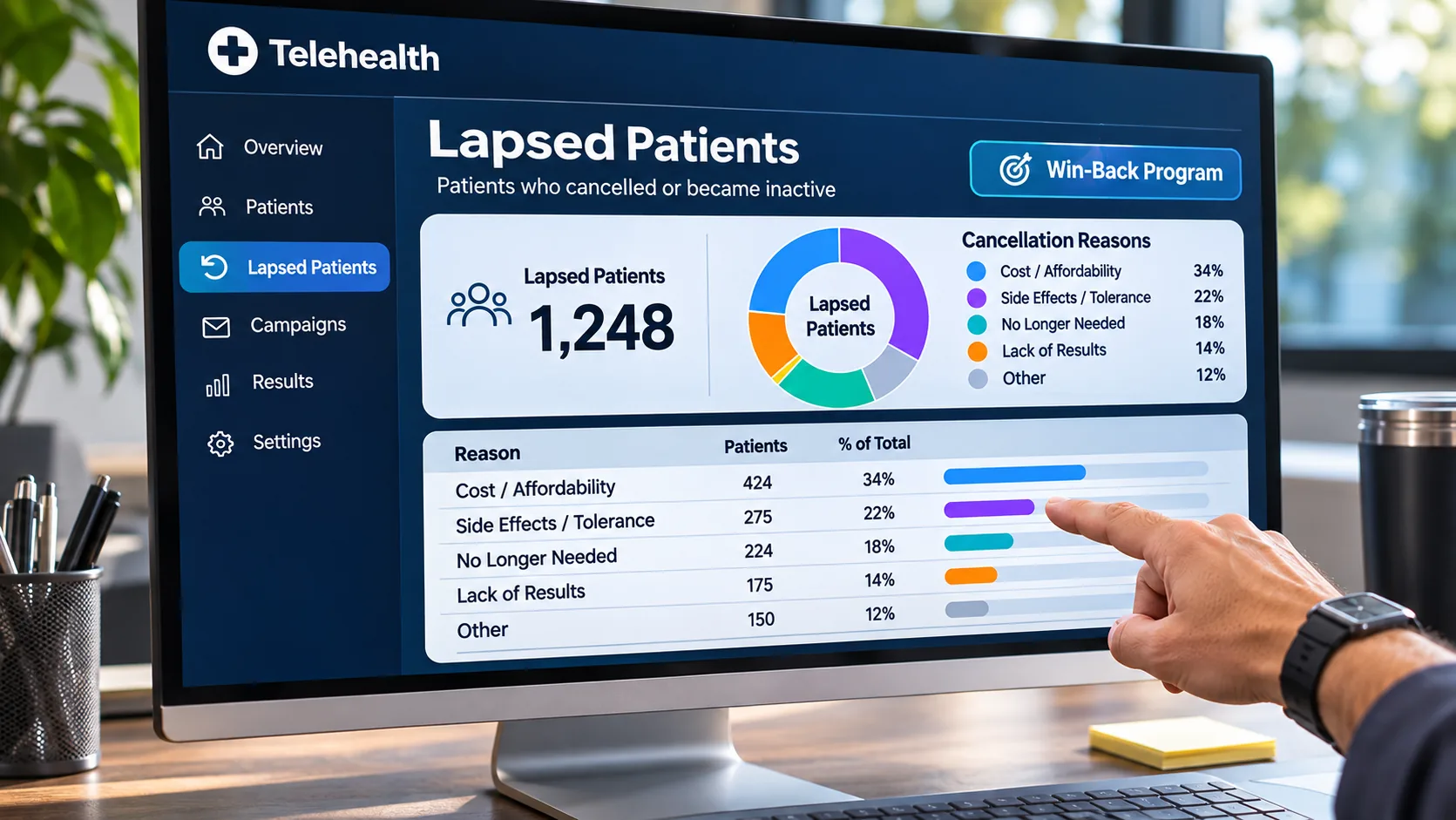
Segmenting by lapse reason, tenure, and engagement history is what turns a one-off blast into a program, and building those segments takes data most email platforms don't hold on their own.
What separates a real program from a reactivation blast
In a patient win-back campaign, timing matters as much as the message. Someone who lapsed last week is in a very different place than someone who left six months ago, and a strong program reaches each at intervals that fit where they are.
Channel matters too. Some former patients respond best to a thoughtful email marketing sequence; others are far more likely to answer a short text. Coordinating the two so nobody gets hit from both sides at once is the same challenge we cover in email and SMS orchestration.
Underneath it sits the data. Lapse reason usually lives in cancellation surveys, support tickets, or billing records rather than in your ESP. Email integration brings those signals together. Email automations act on them, routing each patient down the right path and stopping the moment they return.
Compliance runs through all of it. Former patients are still protected under HIPAA, and opt-out status has to be honored precisely.
Done well, a win-back program feels less like marketing and more like a door left open. That's harder to build than it sounds, and it's where experience pays for itself.
Your next patients may already be in your database
The patients who left your program aren't strangers. They know what you offer, and many would come back if someone gave them a good reason at the right moment.
A structured patient win-back campaign is one of the fastest ways to add revenue without adding acquisition spend. It also closes the loop on the retention lifecycle outlined in GLP-1 patient retention.
If you're sitting on a list of lapsed patients with no clear plan for them, it may be worth a conversation about what that list could be worth. The Wired Messenger team is glad to talk it through whenever you're ready.