
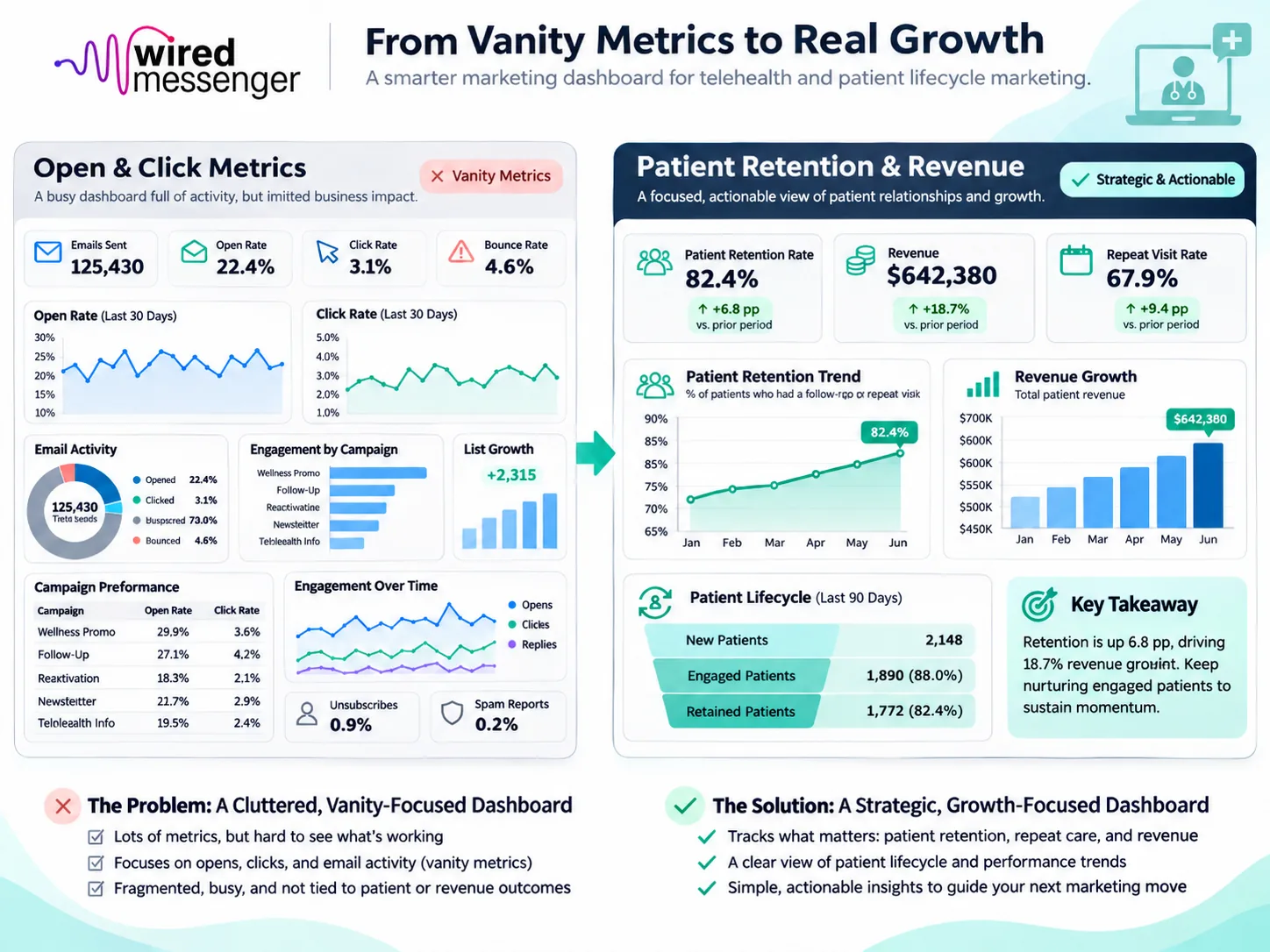
Open a typical GLP-1 program's email report and you'll find telehealth email marketing metrics that look healthy and say very little. Open rate up two points. Click rate steady. List size climbing.
Then someone from finance asks whether email is actually keeping patients longer, and the room goes quiet.
That isn't a failure of effort. It's a failure of what gets measured. The numbers that make a dashboard look busy are rarely the ones that explain whether the business is getting stronger.
The vanity numbers worth retiring
Open rate is the obvious one. Since Apple's Mail Privacy Protection began preloading emails, opens are inflated for a large share of recipients, so the number now reflects email clients as much as patients. It still has narrow technical uses. As a headline KPI, it misleads.
Raw click rate is close behind. A click says someone was curious. It doesn't say whether they refilled, stayed, or came back.
List size and send volume round out the set. A bigger list padded with disengaged patients can drag down deliverability, and rising send counts often signal a program compensating for weak targeting.
Then there's ESP-attributed revenue, the figure most platforms show by default. It's usually last-touch, generous, and impossible to reconcile with finance's numbers. Executives learn to discount it, and the email program along with it.
None of these needs to vanish entirely. They just don't belong at the top of the report.
The telehealth email marketing metrics that tie to the business
The metrics that matter answer one question: is the lifecycle changing how patients behave, and is that showing up in revenue?
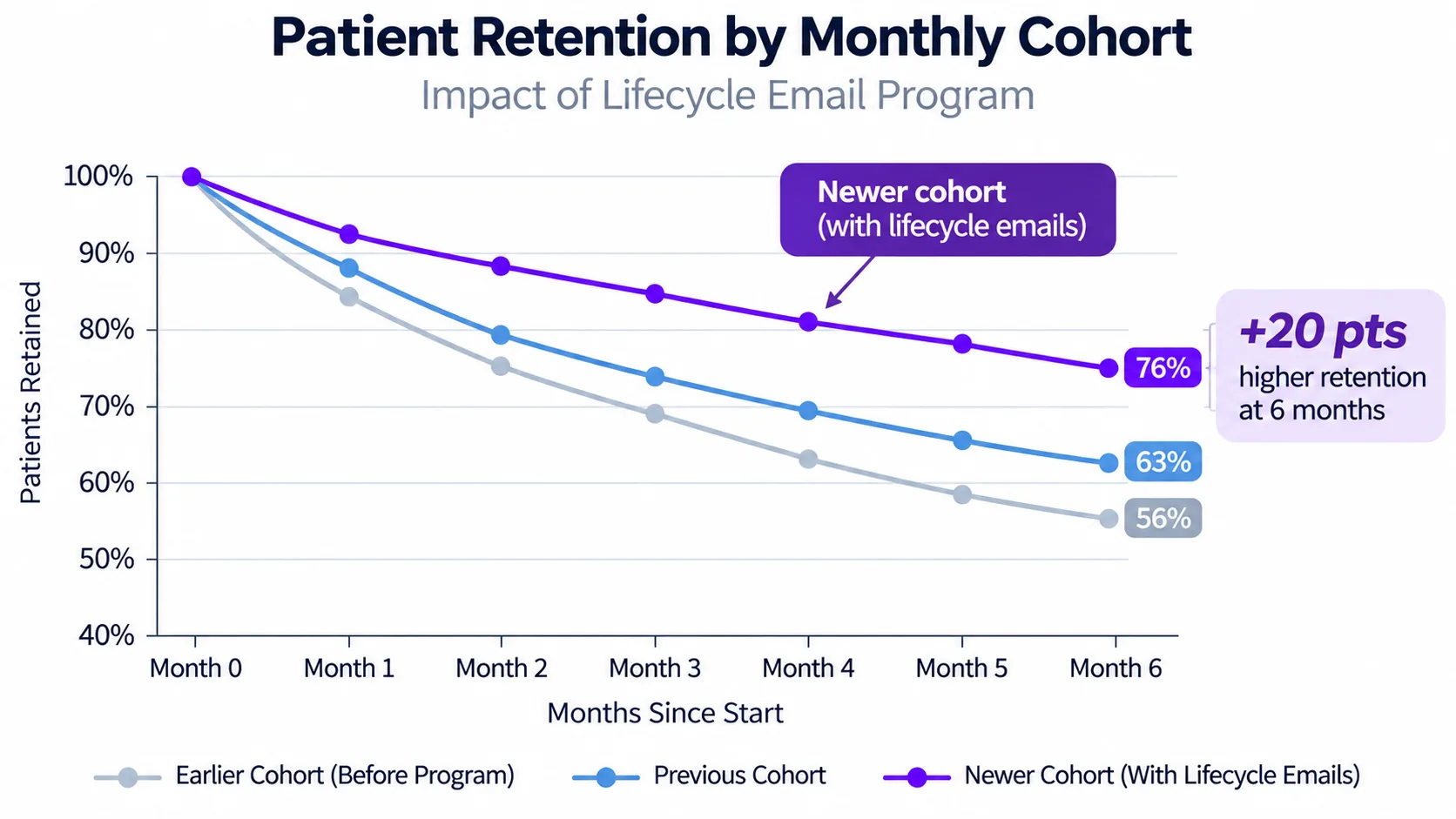
Retention by cohort
Grouping patients by start month shows how many remain active at 30, 60, and 90 days and beyond. When a new onboarding flow launches, cohort retention is where its impact actually appears. It's also the clearest view of what drop-off really costs, which we explore in the true cost of patient churn.
Refill rate and timing
What share of patients refill on time, and how many need a reminder or a payment fix to get there? This is where lifecycle messaging touches revenue most directly, month after month.
Revenue per patient
Measured over a defined window, it captures the combined effect of tenure, upgrades, and add-ons. Tracked by cohort, it rolls up into the lifetime value model laid out in patient lifetime value in GLP-1 telehealth.
Recovery and reactivation
How many failed payments get resolved, and how many lapsed patients come back? Both represent recoverable revenue, and both depend heavily on well-built automation.
Beneath these sit a few health indicators: deliverability, complaint rate, and unsubscribes by flow. They don't belong in the executive summary, but when they slip, everything above them slips too.
Why reporting in business terms is harder than it looks
If these metrics are so clearly better, why don't more programs report them?
Mostly because the data lives in the wrong places. Retention and refill data sit in billing and pharmacy systems. Revenue sits with finance. The ESP sees opens and clicks. Connecting them takes integration work, consistent patient identifiers across systems, and careful handling of protected health information.
Attribution adds another wrinkle. Showing that a lifecycle change moved retention means comparing cohorts, using holdout groups where they make sense, and resisting the temptation to credit email for everything.
This is where an email marketing strategy either matures or stalls. Programs that make the jump stop defending their budget with engagement charts and start showing up in the same conversations as acquisition and operations. If you're unsure where your own reporting stands, it's often the first gap a lifecycle marketing audit uncovers, and closing it goes faster with a partner who has built that bridge before.
Report what the business actually runs on
Executives don't need more email data. They need fewer, better numbers that connect lifecycle work to retention and revenue.
The right telehealth email marketing metrics make that connection visible. They show where patients are staying longer, where refills are slipping, and where the lifecycle is paying for itself.
If your email reporting still leads with open rate, it may be time for a different kind of report. Wired Messenger's email automation and integration services include reporting built around the numbers your leadership team already uses to run the business.