
GLP-1 patient retention has quietly become the single biggest profit leak in subscription healthcare, and most programs don't see it until the revenue numbers stop matching the growth story. Acquisition is working. Patients are signing up. Then, somewhere between month one and month three, they start disappearing.
The number circulating among GLP-1 and subscription healthcare operators right now is $200 to $400 lost per patient, per month. For a program doing seven figures a year, that's not a rounding error. It's the difference between a business that compounds and one that treads water.
The Drop-Off Isn't Hypothetical — It's Documented
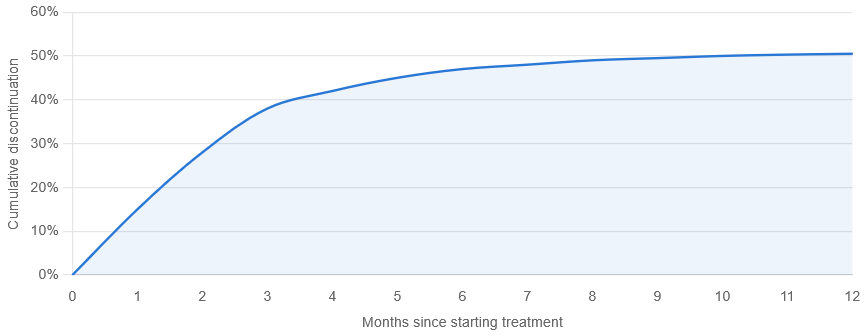
This isn't an internal Wired Messenger estimate dressed up as an industry statistic. A 2025 study published in JAMA Network Open followed more than 125,000 US adults newly prescribed a GLP-1 medication for weight management. Within twelve months, 64.8% of patients without type 2 diabetes had discontinued treatment, compared to 46.5% of those with diabetes.
A separate meta-analysis pooling eleven studies found that roughly half of all patients starting a GLP-1 stop within the first year, regardless of indication. The pattern researchers keep flagging is consistent: a steep decline in the first ninety days, followed by a slower, longer tail of attrition.
That first-quarter cliff is exactly where most lifecycle programs fall apart. Onboarding emails go out. Then nothing meaningful happens until a renewal reminder fires, usually late, sometimes never.
Cost, side effects, and weight-loss plateaus all play a role in why patients stop. But none of that explains why a program with a working product and a fully funded ESP still can't keep a patient engaged through the exact window when they're most likely to quit.
Retention Isn't a Messaging Problem. It's an Infrastructure One
Most GLP-1 operators assume the fix is better copy or a smarter send schedule. That instinct isn't wrong, exactly. It's just aimed at the wrong layer of the problem.
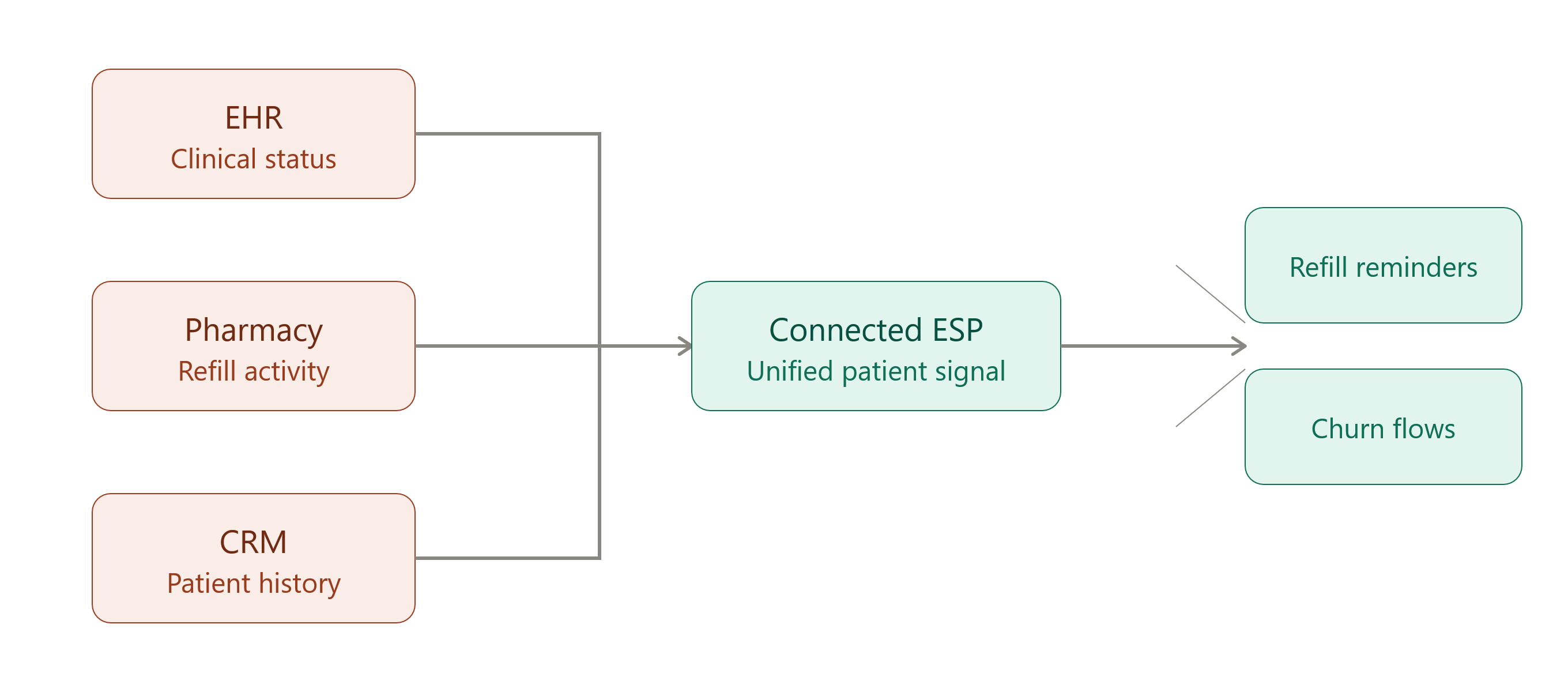
Refill reminders can't fire on a real signal if intake, EHR, and pharmacy data never make it cleanly into the ESP in the first place. Churn-prevention flows can't trigger at day 30 or day 60 if nobody's tracking where each patient actually sits in their treatment journey. A beautifully written win-back email sent to the wrong segment, at the wrong moment, does less than nothing.
This is the gap between having an ESP and having a lifecycle. Plenty of GLP-1 programs are paying for Customer.io or Klaviyo and using a fraction of what either platform is built to do, because nobody connected the backend systems that make automation trustworthy.
Fixing that requires three things working together: a strategy that maps exactly where patients fall off, a data architecture that gets clean signal from EHR and pharmacy systems into the ESP, and a team that owns the lifecycle end to end. Most vendors are equipped to deliver one of the three. Very few deliver all three as a connected system.
What Programs Get Wrong When They Try to Fix It Alone
A freelancer can configure a flow. An in-house marketer, already stretched across five other priorities, can write decent copy. A general email agency can point to case studies from consumer brands that have nothing to do with FHIR data or HIPAA-compliant opt-out logic.
None of that solves the underlying problem, which is architectural. Patient data has to move reliably between systems that were never designed to talk to each other, and someone has to own that connection long after the initial setup is finished.
Programs that get this right treat lifecycle infrastructure the way they'd treat any other core system: something built deliberately, monitored continuously, and owned by people who understand both the technical and clinical sides of the equation.
The programs still losing $200 to $400 per patient every month are almost always missing one of those three pieces, not all of them. Which piece it is determines how the fix gets scoped.
Partnering with a team that has actually built this infrastructure inside live GLP-1 programs tends to close the gap faster than another round of internal experimentation. Wired Messenger's Lifecycle Infrastructure System was built specifically for subscription healthcare programs facing exactly this kind of drop-off, and it starts with a straightforward audit of where the leak is actually happening. If your retention numbers haven't matched your acquisition growth in a while, that conversation might be worth having sooner rather than later.