
Choosing the right email service provider is one of the more consequential infrastructure decisions a telehealth operator makes. Get it right, and you have a platform capable of powering sophisticated, behaviour-driven patient communication at scale. Get it wrong, or choose the right platform and configure it poorly, and you're running expensive acquisition into a retention system that was never built to hold.
Customer.io has become the platform of choice for a growing number of GLP-1 and telehealth operators, and for good reason. But the gap between having a Customer.io account and having a Customer.io setup that actually performs is wider than most operators realize until they're already deep into it.
What Makes Customer.io the Right Fit for Telehealth
Not every ESP was built with the complexity of healthcare-adjacent communication in mind. Many of the more common platforms prioritize ease of use and broad e-commerce applications over the kind of behavioural depth and data architecture that telehealth operators actually need.
Customer.io for telehealth works because the platform was designed around event-driven logic. Rather than organizing communication around static lists and scheduled sends, it responds to what patients actually do: completing intake, opening a specific email, skipping a refill, reaching a treatment milestone, or going quiet after a period of regular engagement. That behavioural foundation is what makes it possible to build communication sequences that feel timely and relevant rather than generic and intrusive.
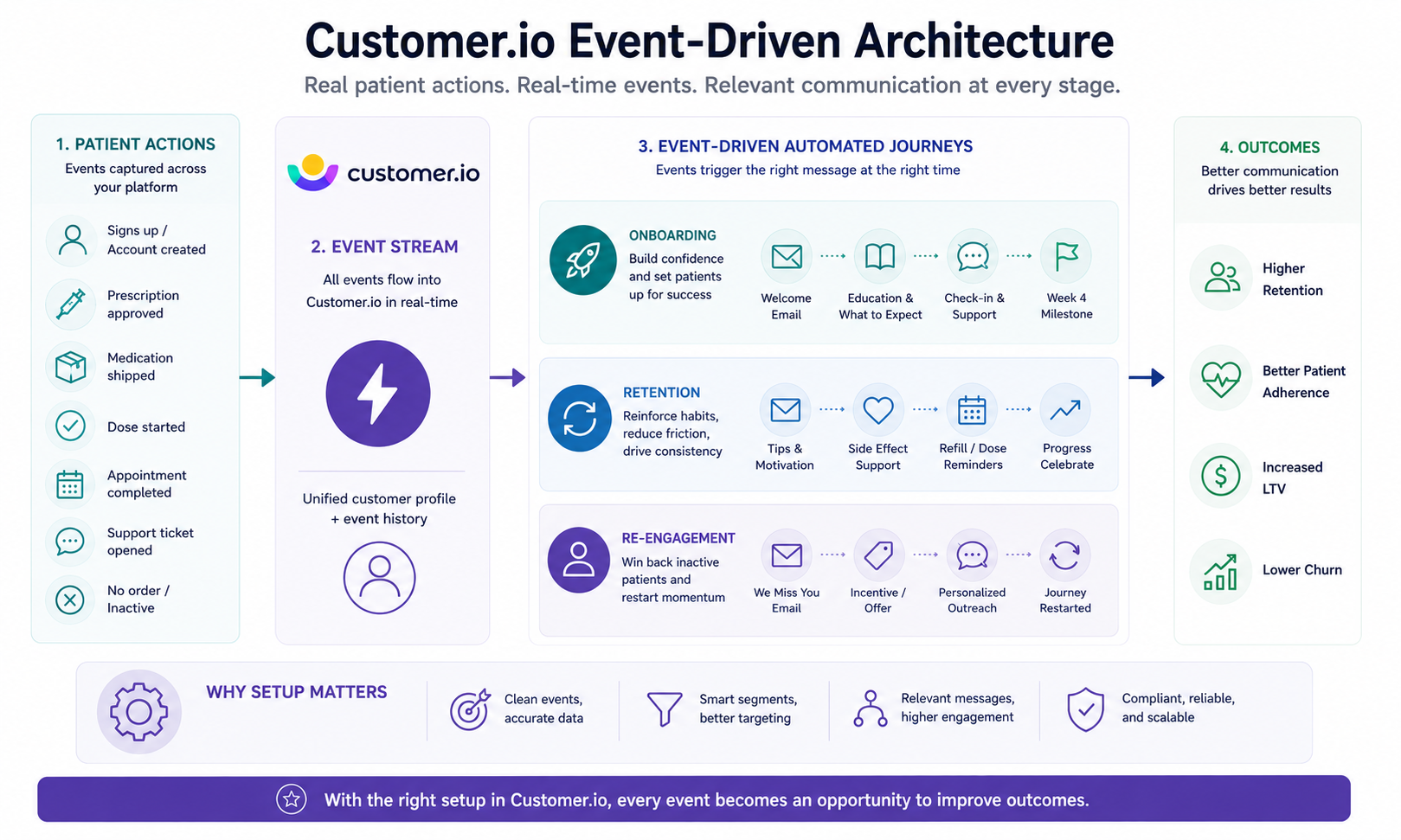
The platform also handles data segmentation at a level of granularity that matters in this space. GLP-1 patients in week two of treatment have different informational needs than patients in month four. Patients who engaged heavily with onboarding content behave differently from those who completed intake and went quiet. Customer.io's segmentation logic makes it possible to speak to those differences precisely, without manually managing dozens of separate lists.
For operators who are already running or building toward HIPAA-compliant infrastructure, Customer.io's data handling and BAA availability make it a defensible choice in a way that several of its competitors simply aren't.
Why Having It and Using It Well Are Two Different Things
This is where a lot of telehealth operators find themselves in a frustrating position. They've made the right platform decision. They've invested in the subscription. And they're still not seeing the retention results they expected, because the platform is configured in a way that only uses a fraction of its actual capability.
The most common configuration gaps tend to follow a pattern.
Event tracking is incomplete or inconsistent. Customer.io's behavioural logic is only as good as the event data it receives. Operators who haven't mapped their patient journey into a clean event taxonomy, or who have events firing inconsistently across web, app, and intake systems, are running behavioural automation on a broken foundation. The sequences trigger at the wrong times, or don't trigger at all.
Segmentation is built on demographics instead of behaviour. Segmenting by signup date or subscription tier is a starting point, not a strategy. The operators getting the most out of Customer.io are segmenting on engagement signals: who opened, who clicked, who refilled early, who hasn't logged in since week one. That requires both the right event data and the intentional segment architecture to act on it.
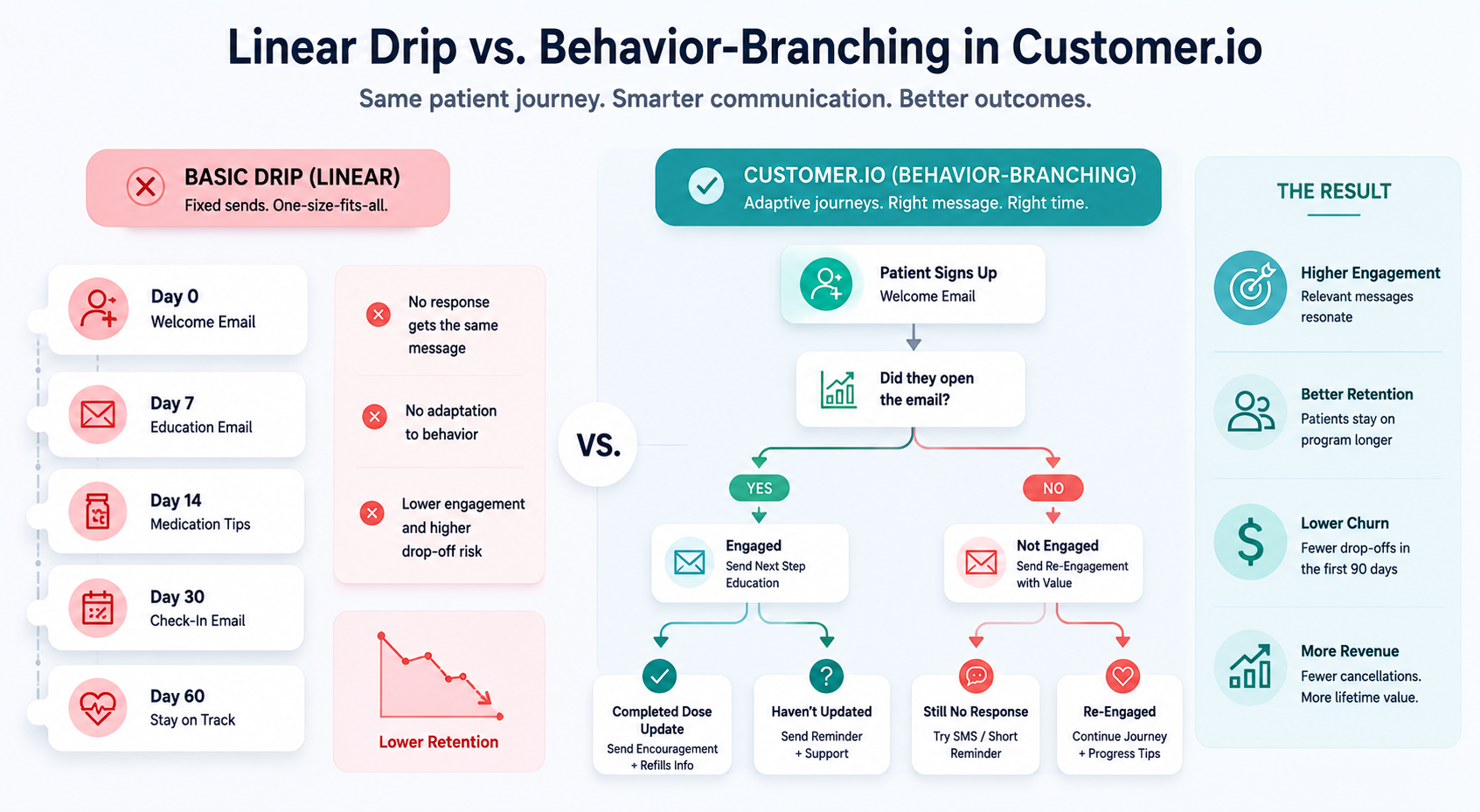
Sequences are linear when they should be adaptive. A common early-stage setup mistake is building onboarding and retention sequences as fixed drip campaigns, email one on day one, email two on day three, email three on day seven, regardless of what the patient does in between. Customer.io is built to do considerably more than that. Sequences that branch based on patient behaviour, suppress messages when engagement signals shift, and re-route patients who hit specific milestones deliver better outcomes than their linear equivalents.
Deliverability infrastructure hasn't been properly established. Sending domain authentication, IP warming, suppression list hygiene, and bounce handling aren't glamorous setup tasks, but they're the foundation that determines whether patient communication reaches the inbox at all. Skipping or rushing through this layer is one of the more common reasons a technically capable setup still underperforms.
The Configuration Problem Is More Common Than Operators Expect
There's a reasonable assumption that because Customer.io is well-documented and widely used, setting it up correctly is a manageable internal project. For a general SaaS or e-commerce application, that's often true. For a GLP-1 telehealth platform where the patient journey is complex, the compliance requirements are real, and the cost of early churn is high, the configuration demands are in a different category.
The operators who try to build this internally typically encounter the same set of friction points: the event taxonomy takes longer than expected to get right, behavioural sequences require more strategic thinking than anticipated, and deliverability issues surface only after sending volume has already affected domain reputation. By the time those problems are visible, they're harder to fix than if the foundation had been built correctly at the start.
This connects directly to the broader challenge of GLP-1 patient drop-off in the first 90 days. A misconfigured Customer.io setup doesn't just limit your platform's capability. It actively contributes to the communication gaps that drive early churn, because the right messages aren't reaching the right patients at the right moments.
What a Purpose-Built Setup Actually Looks Like
A Customer.io configuration built specifically for telehealth lifecycle marketing starts with the patient journey, not the platform. That means mapping every meaningful patient action into a clean event schema before a single sequence is built. It means designing segment logic that reflects treatment stage, engagement behaviour, and clinical context. It means building sequences that respond to what patients do rather than simply counting days since signup.
It also means establishing the deliverability infrastructure that allows the platform to perform at scale, and building in the suppression and compliance logic that healthcare-adjacent communication requires. For a fuller picture of what that compliance layer involves, HIPAA-compliant email automation covers the specific considerations that telehealth operators need to account for in their setup.
The result of getting all of this right is an email program that functions the way Customer.io was designed to function: as a behavioural communication engine that makes patient retention a systematic outcome rather than an unpredictable one. That's the foundation a well-executed email lifecycle marketing strategy for telehealth is built on.
Getting More From the Platform You Already Have
For operators who already have Customer.io in place, the question isn't whether the platform can do more. It can. The question is whether the current configuration is built to access that capability, and whether the team managing it has the lifecycle strategy expertise to put it to work.
Wired Messenger specializes in building and optimizing Customer.io setups for GLP-1 and telehealth operators. If your current configuration isn't delivering the retention outcomes your patient acquisition spend deserves, it may be time to look at what's actually under the hood.